Wednesday, February 5, 2014

Merzbow Ate My Radiator

Quite possibly the most polarizing, abrasive genre of music out there lies Noise.  Noise is as it sounds.  Cacophonous.  Grating.  Schizophrenic.  Hopeless. Messy. Spastic.  Ear piercing.  In other words, just all around unpleasant.  This begs the question, why on Earth would anyone listen to Noise?


Noise can offer catharsis.  You wake up. Go to work. Go Home. Go to sleep. Wake up. Go to work. Go home. Go to sleep. Wake up. Go to work. Go home. Go to sleep.  Wake up. Go to work. Go home. Go to sleep.  Wake up. Go to work. Go home. Go to sleep.  Wake up. Go to work. Go home. Go to sleep.  Wake up. Go to work. Go home. Go to sleep.  Wake up. Go to work. Go home. Go to sleep.  Wake up. Go to work. Go home. Go to sleep.  SKSKSKSKSKSKSKSKSKSKSKKSKSKSKSKKSKSSKKSSSKSKSKSKSKSKSKSKSKSKS
After a while, life melds into the background, and noise is the only release.  Some noise artists are built upon a foundation of repetition with occasional bursts of violent sound.  This style of almost ambient can create a sort of Zen sadism that offers a release from the daily grind.


Noise can offer peace.  Artists such as Merzbow create an isolating white noise that builds a shimmering drone almost suited for meditative purposes.  The Boredoms' Super Ae is probably the best example of this phenomenon.  Over seven tracks, three of which clock in at over twelve minutes, its easy to get lost in the warmth.


Noise can offer popularity.  "WTF?" you might be asking yourself.  But there is a precedent.  The aforementioned Boredoms early career culminated with appearances at Lollapalooza and noise rock pioneers Sonic Youth are well-known and established artists far beyond the Noise scene.  For more recent examples, one can look to the trashy synth sounds that crop up in many pop songs today.  The influence of noise is prevalent everywhere from Kanye West to Ke$ha.


Noise can offer acceptance.  Like many niche genres, followers of Noise build a cult around what they believe in.  The genre offers a sort of nihilism that takes the negative, "fuck you" attitude of punk and metal then twists and perverts it into something that is found nowhere else save for some of the more depraved grindcore acts.  The scene has even fallen back on using dead formats to spread the word, with cassette releases being very common.  A well-known noise label RRRecords even has a series of noise releases titled Recycled Music that re-purpose cassettes found in thift stores, recording over them and slapping a label on it for the artist in question.


Acts like Wolf Eyes and Whitehouse most fully embody the harsh polarizing sounds most associated with Noise, not  being content to offer mere mind-torching static and feedback but peppering their tracks with unsettling titles evoking morbid or disgusting images in the mind's eye like Wolf Eyes' "Black Vomit" and "Dead in a Boat".  Whitehouse takes an even more unpleasant route by splicing in sound bytes from rape victims' cries for help and serial killers' confessionals.  Even the most staunch Noise defenders find such music often unapproachable and more of an exercise in endurance rather than generating any kind of pleasure from the listening experience.


So what's the point?  Well, there isn't one.  much like Noise itself, sometimes the need to get something out there overrules the desire to create meaning in what you do.

Wednesday, January 29, 2014

Cassette Killed The 8-Track Star

I have a deep-seated but somewhat irrational love for cassettes.  Wandering around in thrift stores, I still find myself buying them every once in a while if it's a particularly interesting-looking album.  And if it's 80's metal, a cassette is really the only format the genre should be experienced on.  For example, I recently acquired Poison's Look What The Cat Dragged In.  Now to be clear, I don't like Poison, and I never really did.  But for some reason, I felt at the core of my being that having that album on cassette was the right thing to do.  Somehow it seemed like slotting that cassette in my collection alongside the Tangerine Dream and Dio just makes sense.  It's unfortunate that I do not own a Trans Am with a cassette player since this is the preferred way to listen to any cassette, especially if you sport a mullet with cutoff jean shorts. 
Every child of the 80's owns this whether you know it or not.
So... what is up with this love affair with a format that saw massive popularity for a relatively short period of time in the grand scheme of music formats and then died a cold, hard death at the foot of the juggernaut that is the compact disc (that itself is dying due to the rise of digital downloads)?  Well, I grew up in the 80's, but that doesn't really explain anything.  I didn't really get into music extensively until the early 90's, a time when cassette sales were on the decline.  If you know me though, then you know I am a bargain shopper.  Even at the age of twelve, this mentality was ingrained in me, although more due out of necessity than any sort of force of habit.  My parents were not big money makers, and I had to make due to with a fairly small allowance.  So I learned to make the most with what I had, which meant digging in clearance bins through Extreme and Meatloaf cassingles (cassette singles for those of you that aren't hip to the lingo) to find the occasional treasure such as the awesome "Last Tango in Paris", a Queensryche B-side found on the flip side of "Real World", a song featured in Last Action Hero.  And if a cassette was, on average, $2 or $3 cheaper than the same album on CD?  It was a no-brainer.  I would buy the cassette every time.  
I literally could not find a single picture of the Queensryche cassette single on the internet...
This saddens me far greater than it probably should.

Often when people my age talk about the first album they own, it's more often than not a point of embarrassment (the first cassette my friend ever owned was New Kids on the Block, although he's suspiciously quick to point out that his parents bought it for him without his knowledge).  Tastes change, and often younger people tended to follow the herd mentality and listen to whatever was most popular at the time.  As a result, many people associate cassettes with shame, spouting early album purchases such as MC Hammer and Vanilla Ice.  I'm proud to state that the first three cassettes I've ever owned were not a point of embarrassment at all, and I still own all three of them in their CD incarnations.  The first cassette I ever acquired was The Beastie Boys' License To Ill. It was given to me by one of my cousins, who didn't want it anymore for reasons unknown.  While I don't think this is the Beasties' finest hour, its a great party album and still fun to listen to. 
Yeeeeaaaaaaa!!!!!!!

 The first cassette I ever purchased was Collective Soul's Hints, Allegations and Things Left Unsaid.  Not a masterpiece of 90's alterna-rock by any means but it had several great songs on I still enjoy today.  The question as to whether this really qualifies as my first purchase is a bit iffy in that I bought it at a flea market on Mule Day (yea... small Alabama towns...I dunno...), and upon unwrapping it when I got back to the car, I realized that it was a bootleg copy with no liner notes and the ink printed on the cassette smudged.  I didn't care too much though since it still sounded like Collective Soul.  
Disciplined Breakdown ain't got nothin' on this bad boy.
The first LEGITIMATE cassette I ever bought was Aerosmith's Toys in the Attic.  In the early 90's I started really getting into Aerosmith.  It got to the point that they rose to that prestigious title of "favorite band" even (although after "I Don't Wanna Miss A Thing", my love for them died like a goth kid's black-painted rose placed on the grave of Ian Curtis).  The early 90's brought my first extended exposure to MTV and with it came the barrage of Aerosmith music videos featuring Alicia Silverstone.  While none of those songs were my favorites, it opened the door to deeper cuts like "Eat the Rich" and "F.I.N.E."  The video that started all of it though was Aerosmith's collaboration with Run D.M.C. on a new version of "Walk This Way".  Which finally leads me to why I bought Toys in the Attic.  I didn't even know it was released in the 70's.  I just saw that it had "Walk This Way" on it and had to have it.  I was actually a little disappointed once I listened to the album that the chorus to the Run D.M.C. version was altered, but I got over it.  To this day, while my enjoyment of Aerosmith has faded, Toys in the Attic is still a great album.  "Round and Round" is almost 40 years later still one of the heaviest songs they've ever written (also far superior to the Ratt sound of the same name), and Tom Hamilton still looks like my friend's dad.
Pop Quiz: My friend's dad or Tom Hamilton?
Answer: Both, they're secretly the same person
Unlike vinyl which has some positive attributes to the collector such as the more "pure" analog sound as well as the much larger album art for display and admiration purposes, cassettes do not seem to have much of a following anymore beyond the occasional ironic mixtape and the underground noise and punk scenes (somebody with way too much irony has even been pushing a Cassette Day to record stores).  Cassettes did have their day in the sun though, and I will always have fond memories of the format that introduced me to a wider world of music.  


Thursday, January 23, 2014

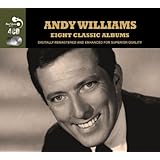
Andy Williams' Eight Classic Albums: It's Bland-tacular!

Before I jump into the deep morass of sedate crooning that is Andy Williams, let me attempt to educate you a little on European copyright law.  In the United States, copyright law on music released between 1923 & 1978 restricts publication of said copyright to the owner for 95 years.  In the United Kingdom, this is not the case.  Essentially, music falls into copyright 50 years after publication, meaning that currently anything from 1963 and previous is public domain.  As a result, many record labels have sprung up to leap at this opportunity to release many golden gems from 60's and previous that are heretofore unattainable except by the original copyright holder in the US.  They then import these releases into the US very cheaply.

Now here's the rub.  Often the quality of these releases is shoddy, containing poorly compressed non-master tracks (sometimes including hiss of a needle as they were ripped from the LP) with limited to no liner notes.  Now a few of these companies like JSP Records actually do a bang-up job of re-mastering and including well-written liner notes while still offering a reasonably affordable package.

Then you have Real Gone as an extreme in the other direction.  Real Gone releases primarily 4-disc sets of generally 6 to 8 full albums (depending on album length) by a particular artist.  The liner notes are typically sparse to non-existent, but surprisingly the quality of the releases is typically pretty decent.  More often than not they seem to be CD rips, although I have heard a few albums here and there that seems to have been lifted from the original LP.  Occasionally you have compression problems, but it crops up randomly and infrequently enough to not be too much of a bother.  The real clincher for me on these is that they can be found for as cheap as $8 a set which is a steal given the quality is relatively good.  The other benefit is they have released so many of these sets in the last two years that they have released many sets by more obscure artists that would not have normally merited a 4-disc box set.

Which leads me FINALLY to my review of the Andy Williams: Eight Classic Albums set.  First of all, in case you are wondering, this DOES NOT include Moon River.  What it does collect is Andy Williams' first eight studio albums (Moon River came three albums later for those of you curious for some reason), all released on Cadence Records before he made the jump to Columbia.  This includes his output from 1957 to 1961.  Nowadays it boggles the mind to imagine artists releasing as many as four or five albums a year, but it was pretty commonplace back in the fifties and sixties.  This was partially due to the amount of songs performed by artists that were written by others.  They didn't need a several month gap between recordings to compile new material.  Often they would just pull up the book of established standards or recent pop hits of the time period and cover them.  Both of these examples are in evidence a-plenty in this box set.

Leading off with Andy's first album is Andy Williams Sings Steve Allen.  For those keeping score, we are talking about Steve Allen, the comedian and host of The Late Show.  In addition to his more profitable pursuits, he also recorded several jazz albums, primarily offering songwriting and piano accompaniment to more accomplished musicians.  These were typically a combination of bebop and torch songs, which Andy Williams on this album performs to some degree of success.  Having primarily known Williams for his post-Moon River easy listening career, it was something of a treat to hear him evoking a lighter and rawer tone on this release.  For the most part the accompaniment is sparse, offering a combination of slower ballads and bouncy bebop numbers.  This is Andy at his liveliest and one of the better albums in the set.

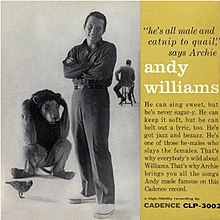
Following it up is Williams' self-titled album (actually a compilation of singles), originally given the odd title "He's All Male and Catnip to Quail," Says Archie.  The title comes from Archie Bleyer, the head of Cadence Records, and his insistence at the time of titling albums with some sort of descriptive commentary based on most likely his own personal opinion of the album (other examples include The Everly Brothers' "They're Off and Rolling," says Archie and The Chordettes' "They're Riding High," says Archie.  I don't know what Andy did to deserve this title, but it definitely takes the cake in weirdness.  The album itself is a bit of an outsider in his catalog as well, offering more country- and rock-based instrumentation often in lieu of his typical piano and string accompaniment.  The album feels a little schizophrenic at times because of this and may not be terribly pleasing to more traditional Williams fans, but I felt it was one of the more interesting albums in the set and was able to hold my attention from beginning to end.

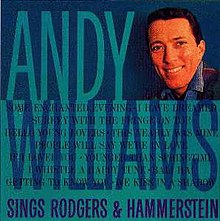
Up next is Andy Williams Sings Rodgers and Hammerstein, and this is the point at which Williams begins to lose me.  With tracks from Oklahoma!, South Pacific, Carousel and The King & I (all musicals I did not care for), Andy was going whole hog with a cash grab.  At the time of this album's release, tracks from all these musicals from multiple different artists were dominating the Billboard charts, and I suppose Andy wanted a piece of that action.  The majority of this album settles into William's usual groove of churning out predictable, straight laced versions of well-established hits and is all for the worse because of it.

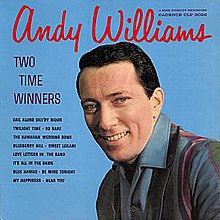
Speaking of cash grabs, the next album on the chopping block is Two-Time Winners.  In a similar vein to his ode to Rodgers and Hammerstein, Two-Time Winners  features all songs that were previously hits for someone else twice or performed in two different ways (i.e. "Blue Hawaii" being a hit for Bing Crosby and also having an instrumental version performed by Billy Vaughn & Orchestra).  Once again, I must express disdain for these lukewarm versions of well-known classics.  I wish to point out particular disappointment with Williams' rendition of "Blueberry Hill".  I have a great fondness and sense of nostalgia for the excellent Fats Domino version and am borderline offended by the stilted performance Williams phones in on this one.  This album worked out for Williams in the end though as he had a great amount of success with "Hawaiian Wedding Song", so much so that the next album he recorded was comprised entirely of Hawaiian songs, giving an excuse to feature "Hawaiian Wedding Song" again...

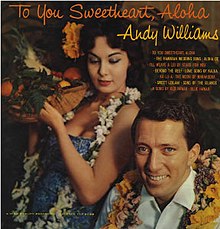
...Which flows nicely into our next album, To You Sweetheart, Aloha.  Honestly, if you changed the instrumentation slightly (replace ukulele with violin, etc.), this could be just another easy listening Andy Williams album.  For an album comprised entirely of Hawaiian songs, it seems totally devoid of cultural significance.  Given that this album probably only exists because Williams had a hit with "Hawaiian Wedding Song" does nothing to boost its credentials (It probably also didn't hurt that America was in the embrace of Hawaii-mania with the admission of the 50th state into the union the year of this release).

Lonely Street is the sixth album in this collection and a little bit of a departure from the previous string of albums in that thematically this is a much darker affair than Williams is typically used to.  His delivery seems a little deeper and more impassioned as well (at least as impassioned as Williams gets).  The album was conceived as a way to ape Sinatra's recent success with In The Wee Small Hours  and Sings for Only the Lonely, which were all about doom 'n' gloom.  I have to call out that I felt Williams' covers of "Unchained Melody" and "I'm So Lonesome I Could Cry" are far inferior to the more well-known Righteous Brothers and Hank Williams versions.  While I won't say this album is a fully qualified success (it drags a little too much for that and includes the unfortunate renditions mentioned), it is still an improvement over the last three albums and a sign that all hope is not lost with this set.

Perhaps as a way of digging himself out of the dumps, Andy's next album is a collection of popular uplifting spirituals called The Village of St. Bernadette.  In general, while this album isn't my cup of tea, I have to admit that the fuller sound granted by the backing orchestra and choir is appealingly exuberant and suits Williams' voice well.  He even has a slight call back to his earlier jazzy releases with a toe-tapping version of "He's Got the Whole World in His Hands" that bounces where it should but not so much as to get the non-secular target audience in a tizzy.

Ending on a positive note, the final album in this collection, Under Paris Skies,  finds Andy flying out to Paris and recording with an orchestra conducted by the great Quincy Jones.  The pedigree on this album is immediately noticeable with full, and most importantly authentic-sounding, instrumentation backing an album of Chanson (and Chanson-like) standards.  According to comments by Williams himself, the band was a little more relaxed and unaccustomed to a tight schedule as he, but the end result was worth it.  I have to agree with sentiment as I enjoyed this album more than any other since his debut of Steve Allen songs.

In the end, looking back on the 5+ hours of Andy Williams I just subjected myself to, i ask myself, "Was it worth it?"  I think overall, yes.  While Williams is not without his fair share of out-for-a-buck toss-offs and barely-there easy listening pap, this collection offered a wider breath of music than I was previously aware from Mr. Williams.  And while I don't see myself returning to this particular well over and over again, the collection is not without merit and some of these songs could end up making their way into my regular rotation.  Plus, at $8 for this whole set, the price is right.

Wednesday, January 22, 2014

Songs Ruined By Movies

In the history of film, it is not uncommon for soundtrack producers to snatch up a great song to use in a pivotal scene in a film.  More often than not, the song has already established a degree of awesomeness that supersedes the mediocre of the film it accompanies.  Or in some cases, compliments the film to such a point that it elevates them both (see pretty much any Quentin Tarantino soundtrack).  But then every once in a while a movie comes along that has such an overpowering reputation, that it forever tarnishes the sparkle of the song it is affiliated with.  So without further ado....

"Unchained Melody" by The Righteous Brothers

This used to be a great ballad sang passionately by The Righteous Brothers.  Then a Ghost came along with its erotic pottery and ruined the song forever (despite Andy Williams' attempts 25 years previous).  Patrick Swayze was no stranger to music-based soundtracks with Dirty Dancing (nothing to ruin that wasn't already terrible there) and Road House (which only made Jeff Healey more awesome), but he did no favors to "Unchained Melody" with its inclusion in this gloomy weeper.  Unfortunately for The Righteous Brothers, Ghost was a huge box office success whose central tragic romance will forever associate "Unchained Melody" with Patrick Swayze's translucent embrace of Demi Moore.

"New Slang" by The Shins

Unlike some people, I don't hate Garden State.  I thought it was a pretty decent mopey, Indie-ish flick with a really good soundtrack.  The problem I have with the way it handled "New Slang" is the way the song is introduced in the movie.  Zach Braff is in a waiting room at a hospital getting his mope on when Magic Pixie Girl Natalie Portman rudely interrupts his stupor demanding he listen to a song stating "it'll change your life".  Now, I don't know about you, but while I love music and find it to be an important part of my life, I can safely say I have never heard a single song that was so amazing that it changed the very core of my being, altering forever the trajectory of my life.  "New Slang" is a great song, but there is no way it could possibly live up to that expectation.  As a result, it will forever be associated with everything that is wrong in a cloying, saccharine Indie Comedy Drama.

Several songs from the late 60's/early 70's

The Big Chill featured quite a few songs from the late 60's/early 70's, which makes sense given its focus on the ruminations of the Baby Boomer generation looking back from middle age.  Many of these songs are Motown classics like Marvin Gaye's "I Heard It Through The Grapevine" and more than one track from The Temptations.  The Big Chill was a big success at the box office, and it's soundtracks sold very well, forever cementing the association between the two.  Because of this film, many of these songs are now closely affiliated with the Baby Boomer mentality that they were the greatest generation.  As a result, younger generations have started to grow a general distaste with much of this music.  This sentiment was expressed well in the film High Fidelity.  When proposing a list of Top 5 Songs About Death, The Rolling Stones' "You Can't Always Get What You Want" comes up and is immediately shot down due to "it's involvement with The Big Chill".  The song choice is then switched to Gordon Lightfoot's "Wreck of Edmund Fitzgerald", and everyone was satisfied.  Why couldn't The Big Chill leave good music alone?

"Oh Pretty Woman" by Roy Orbison

It's one of the great tragedies in history that whenever someone mentions the name Roy Orbison, a hooker with a heart of gold is the first thing that comes to mind.  Not only has the song "Oh Pretty Woman" been ruined by the almost-titular film, but that song defined Pretty Woman so thoroughly and was such a big hit (the song briefly re-entered the Billboard charts after this film premiered) that the very name Roy Orbison has been tainted with Julia Roberts' gaping maw.  Screw her, screw Richard Gere and screw Garry Marshall.  While "Oh Pretty Woman" is a great song, I'll take "Ooby Dooby" any day.

 "Hallelujah" by Leonard Cohen among others

"Hallelujah" may be both the most welll-constructed and most reviled song on this list due to its insistence in rearing its head in various pop culture ephemera in recent years.  More often that not, Leonard Cohen's version is not the one represented (save for the film Watchmen where it was used in service of a very uncomfortable flashback sequence).  Jeff Buckley's soaring, passionate and, in Jeff Buckley fashion, overwrought version has been the most used and abused, cropping up seemingly everywhere from Shrek to American Idol.  I'm personally partial to John Cale's rendition which Scrubs used in an episode for a typically rollercoaster-of-emotion sequence involving three patients dying at the same time, a bummer of an episode ending even without the haunting melody to accompany it.  "Hallelujah" is a fantastic, beautifully written song by one of the greatest songwriters of the last 50 years, and I honestly never want to hear it again.  

Thursday, January 16, 2014

Lili Haydn's Place Between Places

Something you may not know about me, but explains the ridiculous amount of music I own, is that I often buy albums at thrift stores purely on impulse without prior knowledge of the artist based on factors such as record label, album art or song titles.  Of course, price also factors in, hence thrift stores.  In fact, most thrift stores sell CDs and vinyl so cheap that I have a very low threshold for what appeals to my buyer sensibilities. Which brings me to Lili Haydn.

The album art had a rich and entrancing color palette, and the album was released on Nettwerk, who have been known to distribute such widely diverse artists from Skinny Puppy to Sarah McLachlan.  So it piqued my interested enough to pull it from the rack and scrutinize it a little more.  Track listing?  "Oh snap!", I thought. "She covers Funkadelic's 'Maggot Brain'.  This is probably either awesome or horrible.  Either way, it's a win!" I knew then I had no choice but to fork over a dollar to the bored Salvation Army employee and walk back to my car in the safe knowledge that my day had been productive.

So after a full listen of the album, it's both a little more and a little less than I was expecting.  Lili Haydn approaches music as a sort of baroque (not really... but you know what I mean) folk pop violinist.  The album at it's best offers a densely lush experience that reinforces the classical underpinnings of Haydn's training , best exemplified on such tracks as "Can't Win Everything" but sometimes fades into the background, strong but ultimately unremarkable. "Maggot Brain", which is indeed a near transcendent if brief interpretation, is a little different than most of the album, offering a subdued but passionate rendition not unlike the original.

Do I regret my purchase?  Most certainly not!  While it may not fall into constant rotation in my playlist, it is albums like this that justify my thrift store visits.


Bringing It All Back Home

Looking back at my most "recent" posts on here (over 2 1/2 years ago!), it becomes obvious why I stopped blogging.  I had drifted so far away from the original intent of this blog, I was filling time with video game reviews and copy 'n' paste hack jobs of old posts about movies.  I had the shocking realization that I hadn't even blogged about music since 2008!  Music has been such a big part of my life for as long as I can remember that it borders on blasphemy to uncover this artifact of truth.  In fact, according to my rateyourmusic.com profile, I own close to 14,000 albums in various formats.  It seems almost criminal to not write about at least a small chunk of that.  So here I am, deciding to return to my blogger roots and write about music once again.

For my first blog of the new year, I thought in lieu of anything creative, I would just blog about whatever I happen to be listening to today.  Ease myself back into it, if you will...

School of Rock Soundtrack
It seems appropriate that I would start my date with the soundtrack to a movie that revels in the unbridled passion that drives a person to love making music.  While some thought the typically esoteric and philosophical Richard Linklater's Jack Black bufoonery vehicle was a cash grab, I felt the movie offered more than that with the soundtrack playing a much larger part in its success than many films, and rightly so given the subject matter.  School of Rock: Music from and Inspired by the Motion Picture is, in typical soundtrack fashion, a hodge podge of classic rock tracks and bands that sound like, but aren't, classic rock (That's right fellas, Ramones =classic rock... and mind=blown).  One thing that impressed me is Linklater actually secured the rights to a Led Zeppelin song.  Not only that, but it isn't "Stairway to Heaven",although I imagine the ridiculously cost prohibitive rights played a part in song choice.  To be quite honest, I'm very pleased to see "Immigrant Song" represented since it both rocks harder and is much less overplayed than "Stairway".

In my opinion, the only real weak spots on the album are by the fake band No Vacancy, who's songs sound bland in comparison when played alongside such classic acts as The Who, T-Rex and Cream.  In fact, the School of Rock band's rendition of "It's a Long Way to the Top" is better than any of the No Vacancy tracks.  While the album won't be winning any awards for unique and inventive song choice (although choosing "Ballrooms of Mars" over the much more common T-Rex song "Bang a Gong" was great to see), overall it's a pretty solid soundtrack for the rock fan or the burgeoning youth who should be.

Thursday, March 24, 2011

My Brain Died...

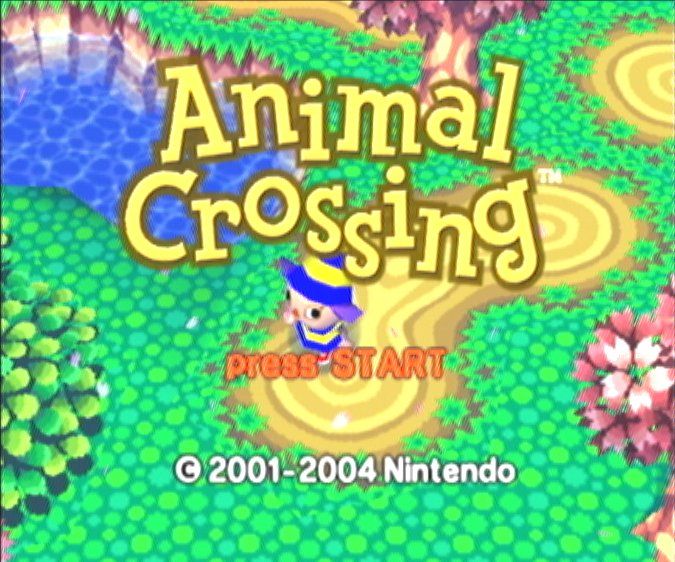
Animal Crossing makes me angry.  On one hand, it is really, really stupid.  On the other hand, I played it for far more hours than I would admit.  I'm lumping in the GameCube and DS versions together since they are basically the same game with minor tweaks despite the DS version being called a sequel.  Given that I am known the world over for my riveting reviews of Tamagotchi Corner Shop Connection 2 and Kururin Splash, who better qualified than me to review this momumentally idiotic non-game?

Reasons why this game sucks:
1. The graphics:

They are overly cutesy and kinda bad.  Given it was ported from a Japanese N64, this is not surprising.  Regardless, they are targeting directly toward 10-year-old girls who love talking animals with big heads and short tempers.  At least the DS version knew how to compensate for its weaker engine by scrolling the world up or down over the horizon as you walk.  Of course being the DS, the textures are even blurrier and crappier.  Oh well...
2. Arranging furniture is stupid:

This is seriously one of the primary focal points of the game.  You decorate your house, and earn money to make it bigger so you can cram more junk in it.  I found myself trying to decorate with the most grim, depressing stuff I could find.  For wall and floor covering, I settled on a cold, hard stone motif to give it that dungeon vibe.  Going for a while without cleaning causes spiders to build webs in the corners which further enhanced the mood I was going for.  The only other way I was able to entertain myself was by amassing these weird-ass cacti things that made bizarre noises when you walked by them.
3. The townspeople are jerks:

Half the bums in this town are outright rude to you at times and stomp around angry for no good reason.  Even when they aren't sulking and whining for no reason, they are sending you off on dumb errands because they are apparently either incredibly lazy or shut-ins afraid to leave the immediate vicinity of their house.  On rare occasions, you do find them out wandering around in the middle of nowhere for no particular reason.  It makes me just want to shake them violently and demand to know why they needed me to deliver their stupid letters.  Additionally Tom Nook is a shifty slave driver.  As soon as you get off the train to go this town, he greets you, seemingly with no ulterior motive.  He goes so far as to find you a house to live in.  But guess what? Nothing in life is free, particularly when dealing with a sketchy raccoon out to plunge you into severe debt in order to use you as his personal slave in his general store.  Then once you do manage to pay off your mortage, what does he do?  Cons you into buying a bigger house, thereby plunging you into even bigger debt, dooming you to plant flowers and pick fruit for him for years to come!  Tom Nook is Satan.  This is the only conclusion I can draw.  I just kept waiting for the proposition where he offers to completely erase my debt, and all he asks for in return in my immortal soul.  No dice, Nook!
4. Fruit selection is lame:

Why can't my town have the good fruit?  I want coconuts, dang it!  How dare you expect me to get a Gameboy Advance and that stupid link cable just to get them!  Fools!  At least in the DS version, they randomly wash up on shore.  although the "Scour The Beach For Coconuts" game gets old real fast.

Reasons why it's actually kinda neat:
1. It plays in real-time:  This is actually pretty neat because a)It allows spiders to infiltrate my house if I forget to log in after a couple of days, which I envariably do, b) neat stuff happens on holidays like the major giving you random junk to throw in your house and various celebrations and c) people in the village remember your birthday, and I always get a warm and fuzzy feeling when people remember my birthday.
2. NES games!!:

 This is the PRIMARY reason I bought and played this game.  You can actually find items that look like NES's, and once you place them in your house, you can actually play the old NES games right there. It has such awesome stuff as Excitebike and Punch Out!!  In the DS version, you can't really find NES games, but you can find special items that are Nintendo references like the Master Sword and Triforce, which is kinda neat but much lamer than actual Nintendo games.
3. My brain sucks:  My brain compels me to collect things.  Ask my wife.  Our house is full of CDs, DVDs, games, books and all matter of other nonsense.  As a result, I played this game a crap ton more than I had expected to due to all the junk you can collect like bugs, fish, fossils and paintings.  The DS version has more junk to collect, so I actually ended up putting more time into it.  That owl in the museum is annoying though.  I just wanted to mention that.

4. convenience: This is a game that is very easy to pick up and put down.  It requires very little time put into in a single game sitting, so it allowed me to just kind of play in my spare time at my leisure.  I only feel like playing for 10 minutes?  That's ok.  I'll just go dig up a couple of fossils and be done.

To summarize, this game is horrible.  As a result, I recommend it to hoarders and people who hate themselves.  I'm not sure which camp I fall into.  Probably a little of both.

Wednesday, March 23, 2011

Rock Band 3 Review FTW!

For those who know me, they are aware of how big a fan I am of the Rock Band games.  As a result, I was anxiously anticipating Rock Band 3.  Not only were they refining and improving the series in small ways to make the whole Rock Band experience work more smoothly, but they were adding the keyboard and Pro Modes for the rest of the instruments.  Needless to say, the game lived up to all my expectations.  I feel that it is pretty much the best music game on the market and has completely blown away the Guitar Hero series, who have started concentrating more and more on silly features like character mutations and boss battles rather than on the reason people play these games: music.

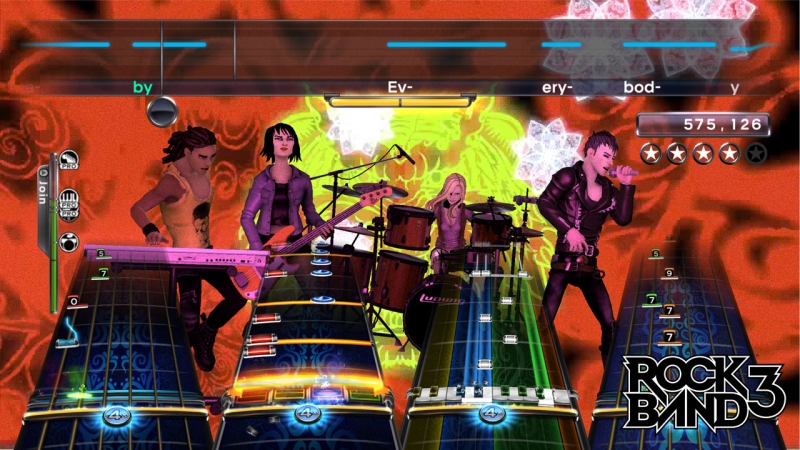
The thing most people have been looking forward to are the keys and Pro modes.  The keyboard is an actual 32-key MIDI-based keyboard that, with an adapter, can actually be used as a real keyboard.  The game has both a standard and pro mode for the keyboard.  The standard mode uses just 5 keys on the keyboard and works very similarly to the guitar controller where the player just presses one of the five colored keys as the colors scroll down.  I found the standard mode to be pretty fun but a little less engaging than most of the other instruments since I only used one hand to play it.  The pro key mode uses the full 32 keys and displays ten keys (as well as sharps/flats) on the screen at a time due to lack of screen real estate.  It shifts the screen left and right to move up and down the keyboard.  To start off, the pro keys mode is really freakin' hard.  It is essentially like playing a real keyboard, albeit a small one.  I could only manage to play a couple of songs on Easy difficulty without constantly missing notes (the INXS song is your friend).  The hardest part of playing on pro keys is finding your place on the board to start out and keeping track of where you are when it shifts the screen.  It definitely takes some getting used to, and since I typically play the game with my wife, I doubt she will have the patience to just sit and watch me try playing the same song over and over until I've got it down.  I honestly don't see a lot of long term use in the keyboard.  Others who are more serious about than myself may find it very beneficial as a jumping off point for learning to play a real keyboard.

The pro drum mode adds cymbals and an extra bass pedal for hi-hats.  I actually didn't have an extra pedal that wasn't broken, so I wasn't able to try the hi hat pedal out, but I did get the cymbal expansion and have played with them quite a bit.  Overall, I found the pro drum mode to be a fun addition.  Since I already played on expert, for most songs they weren't that big a leap to adjust to playing. On the screen, cymbal notes are displayed as round instead of the typical thin rectangle notes, making it very easy to distinguish between regular and cymbal notes, unlike the Guitar series where both the cymbals and regular notes are round.  The only real complaint I have about the cymbal expansions is that they don't fit on the drum set very well and have a habit of sliding down the poles as you play them.  I basically had to anchor them with duct tape. Once I did that, they seemed to be fine.

Pro guitar mode apparently uses a full 6-string guitar controller by Mad Catz or a real Fender guitar to control with the note chart looking not dissimilar to guitar tab.  I personally haven't tried this mode, so I don't really have anything to say about it other than it seems like a really awesome idea.  I have a feeling I will have similar feelings to it as I did with the pro keys mode in that it will be very difficult to learn since it is essentially learning to play a real guitar.  For vocals, they've carried the vocal harmonies feature over from Beatles Rock Band which brings the grand total number of possible players at the same time to eight.  The vocal harmonies work as well here as they do in Beatles Rock Band.  If you have the people to play it, they can present a pretty daunting challenge even for those with perfect pitch.

As far as game modes, Harmonix seems to have kept what they felt worked and added some extra, very much needed features.  The biggest addition to the game is that it is now driven by Career Goals which work similar to the Xbox achievement system or PS3 trophies in that it is a massive list of objectives for the players to achieve that are spread throughout all the various game modes including even the download content.  I found the goals to be pretty cool, extending the life of game well beyond the regular modes are exhausted.  As far as regular modes, taking the place of the Tour mode from the previous games are the Road Challenges.  They play out in a very similar way with your band basically rising in the ranks, getting cooler stuff like buses and jets while playing through various gigs (gigs are comprised of a setlist of songs).  To throw a little variety, sometimes the challenges have different objectives like using as much overdrive as possible or getting long note streaks, not unlike the challenges in the Guitar Hero series.

Speaking of which, with this game Harmonix seems to have studied the recent Guitar Hero games and taken what has worked best.  One of the biggest examples, other than the challenges, is the much needed and greatly appreciated (at least by me) revamped menu system for character and instrument selection.  In previous games if you had multiple people wanting to play, you had to exit all the way out to the first menu of the game to add or remove a player or even change difficulty.  Now it can all be done on the fly: adding or removing players, changing instruments, changing difficulty.  It can all be done in mid-song regardless of what mode you are in.  Another interesting little feature that some achievement hounds who are less than skilled at the game will appreciate is that you can now get achievements with the No Fail Mode turned on.  It works great for when you have that one guy at a party who demands No Fail Mode when everyone else is wanting the multiplayer achievements.

For those of you like myself who have a boatload of download content, the sorting and filtering modes for the song list are vastly improved, giving a lot more flexibility in the way you can scroll through and select songs.  Although I found myself still wanting a filter or two (like filtering out songs you've already played), it is definitely leaps and bounds beyond what was previously available.  The Battle of the Bands and Custom Setlists from Harmonix in Rock Band 2 are still here with the additional ability for players to create their own Battle of the Bands challenges that they can link to on Facebook.  I thought this was a pretty neat addition and had wondered why it wasn't added in RB2.

And even if you didn't care about any of the new features or modes, RB3 also comes with a whole new 83-song setlist.  I can definitely tell an effort was made to pick songs that shined on keyboard.  As a result, you now have stuff like Elton John's "Saturday Night's Alright for Fighting", Queen's "Bohemian Rhapsody" and Chicago's "25 or 6 to 4" which all feature very prominent keyboard parts.  They have also released download content after the game has come out that do not even have guitar like John Lennon's "Imagine".  I find the setlist overall to be a good cross-section of music from every decade with some stuff that genuinely surprised me by their inclusion like The Flaming Lips' "Yoshimi Battles the Pink Robots Pt. 1", which happens to be an awesome song I never expected to show up in Rock Band.  Of course, with their still continuous release of new download content every week and with the Rock Band Network, there are a lot of songs I never thought would be in Rock Band that are now readily available.

In the past, real musicians have seemed to turn their nose down at the music genre in general with claims that they'd "rather play a REAL instrument".  With the Pro Modes this game adds, their scoffs of derision have much less merit than they once did.  In a nutshell, this is a freaking awesome music game.  I understand that the music genre is general is starting to die down in popularity, but if you have even the slightest interest in music at all, give this game a try.

Tuesday, March 22, 2011

Minnesotans Creep Me Out

Puzzle Agent is an odd bird of a game.  Based on the characters created by Graham Annable of Grickle fame(?) and tipping its hat to the Professor Layton series, Puzzle Agent positions itself as a story-driven puzzle game featuring the exploits of Detective Tethers as he solves various puzzles to unravel a bizarre mystery involving secretive cults and sinister lawn gnomes in the frozen wasteland of Scoggins, Minnesota.

The gameplay consists of an interface not unlike many a point-and-click adventure game. Your primary interactions when not solving puzzles involves mainly having conversations with people and collecting chewing gum which acts as the game's hint system.  As for the puzzles themselves, they are, as one would expect, a hodge podge of various puzzles of varying degrees of challenge.  The biggest positive is that no sliding puzzles are to be found!  The puzzles in general are I would say slightly more difficult overall than Professor Layton's but the challenge level seems to be a little more consistent.

The graphics are nothing amazing but get the job done, enhancing the offbeat mood of the game.  The sound and voice acting go a long way in making the game seem more off-kilter as well.  The denizens of Scoggins are an odd bunch indeed.  In fact, the game seems to go out of its way to be as odd as possible.  Anyone expecting a loveable and adventurous romp like Professor Layton will be disappointed by the generally bizarre and vaguely creepy mood of the game.


Overall, I enjoyed the game and while it is rather short (I was able to finish it in roughly 3 hours or so), it is inexpensive.  I would recommend it to those who have enjoyed the Professor Layton games and don't mind a more strange storyline.

This Game's Title Is Way Too Freakin' Long

Peter Jackson's King Kong: The Official Game Of The Movie


With such a long unwieldy title, one would assume that the game would focus on the exploits of the titular giant ape gallavanting through the jungle, smashing villagers and invading film crews.  In reality, a more appropriate title for the game should be Adrian Brody's Sweaty Death Romp since the majority of this game is spent as Jack, Adrian Brody's character from the film, stumbling around the jungle and running from everything including, but not limited to, all manner of dinosaur, giant millipedes, mutant eels and, of course, Kong himself.


The gameplay as Jack is a standard FPS style, and this is where you will spend the majority of your time in this game.  Most levels involve either rescuing/protecting someone, collecting a thing to proceed further into the game, escaping from something trying to kill you or just plain ol' going from point A to point B.  As a nice, and far more awesome, diversion, you additionally will get to play as Kong occasionally.  This involves chasing after things by running along walls and swinging across branches and beating the living bejeezus out of dinosaurs.  The Kong sections use a modified Prince of Persia: Sands of Time engine to facilitate the fluid acrobatic and fighting sections.  And this is what befuddles me the most about this game.  The developers had to know that the Kong sections were more fun, so why didn't they have more of them?  Perhaps they doled the sections out in more bite-sized nuggets so that when you get to them, you are much more appreciative of how awesome they are.  My biggest complaint is that there isn't a Kong section closer to the beginning.  You probably have to play for at least an hour or so as the ho-hum Jack FPS before getting to the Kong action, which could present a deterrent to those wanting to get immediately engaged in the game.  I believe this is the reason they made the achievements so easy.


I'm betting a good 80% to 90% of people who played this game did so to get a full 1000 achievement points with little effort.  Basically you just have to play through the game on any difficulty, which takes roughly 5 or 6 hours.  Although the game can get very challenging in places, the knowledge that another 100 point achievement is just around the corner will keep driving many a player.

The graphics are actually very good if you are playing the Xbox 360 version, particularly the Kong sections.  and while the sound is fairly uninspired, the music cues work very well within the context of the game to give you a sense of ominous foreboding or panic when appropriate.

I dumped on the FPS sections quite a bit but only because they seemed dull in comparison to the Kong sections.  They are actually fairly serviceable FPS sections, presenting a pretty high challenge due to the stinginess of the game in trickling out weapons.  More often than not, I had to rely on throwing spears and bones at vicious, man-meat craving dinosaurs to fend them off due to constantly running out of ammo. Spears?  Against velociraptors?  Seriously? you can see how effective the game is in creating a sense of panic.  Overall, I'd recommend the game to anyone looking for a pretty good way to kill a Saturday afternoon or to anyone who hordes achievements.

Ninjas + Reptiles = Easy Game

TMNT, based on the CGI-fueled film of the same name, involves you playing as four different yet almost identical turtles who have been graced with the freak mutant powers of walking upright and speaking and have been trained in the ways of martial arts by a freak mutant rat who was apparently a big fan of Mr. Miyagi from the Karate Kid movies.  Given the fact that they look identical, they've been given colored headbands and different weapons to tell them apart.  They also each have their own two-dimensional personality trait to further define them.  Unless you randomly clicked this review because of your intense love of acronyms, you probably already know the differences, so I will skip the in-depth profiles.

The gameplay is like a hybrid of Crash Bandicoot and Prince of Persia: Sands of Time.  For the first few levels you alternate through the turtles, giving screen time to each and learning their special moves.  Later it gives you the ability to switch between turtles on the fly and perform special combos with two turtles at once.  The game has you running, jumping and flipping through one highly linear level after another with intermittent breaks to punch and kick street hoodlums and foot soldiers.  Every once in a while you have the requisite boss fight.


The storyline pretty much follows the movie and basically acts to fill in a couple of gaps *as if anyone was wondering how exactly Ralph got from the bottom floor to the top floor of some building.  The whole game is also in flashback, narrated by the turtles, so you are fully aware than none of them suffer any undue consequences of recklessly parading through the city with deadly weapons.

Complaint number one: why do we play through 11 levels before we ever actually play as Raphael instead of his stupid Batman ripoff character?  Complaint number two: the camera is a fool.  It succumbs to the 3rd-person platformer syndrome pretty early.  I found it really irritating not being able to see exactly where I needed to go because the forced camera perspective wouldn't let me.  Far too many times did I find myself leaping randomly into space, hoping a platform was somewhere ahead that I could grab onto.  At least they put a lot of checkpoints everywhere.


Now a few comments that some may find positive and others negative.  First off, the game is incredibly easy and can be beaten in less than five hours.  I'm sure many out there prefer more of a challenge, but if you just want some really easy achievements, this is the game for you.  Also, I mentioned earlier that the game is extremely linear.  Did you notice I compared it to Crash Bandicoot earlier?  THAT is how linear it is.  There is NO deviation from the path the game wants you to follow.  Some people may actually like this so they can focus on speed runs (the game does indeed time you and score you based on how fast you get through the levels).  Any sandbox fans will find it very restrictive and probably lose interest quickly.

I personally found the game to be a pleasant diversion while recovering from surgery and therefore will hesitantly recommend it to people looking for a break between tougher games or for achievement whores.

Tuesday, June 29, 2010

Universal Studios Day 1: Afternoon

JAWS
JAWS… the cheesy, campy ride that everyone immediately thinks of when Universal Studios is mentioned in casual conversation.  People have proposed to their loved ones on this thing, for God’s sake.  So how is it?  Getting on the ride, it actually advertises itself as the Amity Boat Tour.  There was no mention of Jaws other than on the warning sign posted at the entrance.  We began by boarding a Jungle Cruise-esque boat with our nonchalant tour guide pretending to steer the boat as it glided along a track.  The tour was basically structured as a tour of the town of Amity, describing it as the town that suffered the horrible attack of Jaws that the famous movie was based on.  Pretty soon, not surprisingly, the tour comes across another tour boat sinking, having just recently been attacked by Jaws.  Our boat was called in to help just a little too late.  Oh well.  Anyway, the animatronic wonder makes his first appearance with a quick splash and an explosion of a gas station before our guide lobs a grenade at him by using a portable launcher.   

We then head into a boathouse to take cover.  Jaws starts ramming the walls of the boathouse, so we flee only to have him pop out of the water right next to us as the tour guide attempts to lead us to a boat dock.  This boat dock happens to be located right next to a power cable, which Jaws stupidly bites into, frying him dead.  Everyone cheers and we head back to the beginning.  I happened to be sitting on the left side of the boat, which is where you want to be if you want to be splashed or right next to Jaws when he’s at his most “menacing”.  Susan and I both had a campy good time on this ride and it should be held as some sort of rite of passage for theme park enthusiasts.

After Jaws, Susan wanted to go see the Animal Actors on Location show since it was closer to starting time.  I wanted to ride the Men in Black Alien Attack ride so we decided to split up and meet when I was done. 

Men In Black: Alien Attack
A quick note on this one: If you want to get ahead of the line quickly.  Getting in the single rider line is definitely the way to go.  By this time of day, the lines had started getting a little longer but I was able to get almost straight on anyway. 

So MIB: AA as far as I could tell didn’t have much of a storyline to it.  Basically it serves as a recruitment training program for the MIB agents.  The ride itself is on a track similar to a lot of dark house-style rides with the car spinning quickly back and forth a good bit as you spin around firing at aliens.  The firing part is the unique gimmick of this ride as it acts as a sort of shooting gallery with your car being equipped with a gun that you fire at alien targets as the ride progresses.  It basically proceeds in this fashion until you come across a giant alien at the end that apparently involves setting explosives in its mouth that are detonated by driving your car in and spinning around a lot.  This was a fun ride that was worth taking a little time to try out.  For those who get sick on spinning rides like my wife, you might want to stay clear.  Since I was able to get through the line so quickly, I decided to head over to Animal Actors on Location to watch it with Susan since it hadn’t started yet.

Animal Actors On Location
This was most likely Susan’s favorite attraction at the park, only trumped by a squirrel that came up to her foot and looked at her outside the E.T. ride.  It was basically comprised of some animal trainers showing off some movie animals and how they are trained.  It was a pretty interesting show, featuring a bird from Evan Almighty and the lab from Marley and Me, among others.  At one point, a volunteer in the audience sitting right next to me had a bird fly up and snatch a dollar out of his hand.  It was pretty neat to have something like that as close as it was.

After this I was able to convince Susan to ride the E.T. Adventure as I had mentioned earlier and she seemed to enjoy it, partially because the fake E.T. that sat in a basket in front of the bikes was attached to the bike she was on.  After this we attempted to go to the Disaster! Ride but it was having issues, as it had been all day.  Instead we decided to go to Shrek 4D.

Shrek 4D

The interesting thing about the fact that we went to Shrek 4D is that neither of us are big Shrek fans.  We were mostly doing it to kill time until the next showing of Terminator 3D.  The premise of Shrek 4D is that it picks up where the first movie ended.  Basically Prince Farquaad has come back as a ghost and kidnapped Fiona.  Of course, Shrek & Donkey hop in a carriage to give chase and save the day.  So first off, the movie is in 3D, which was very impressive in places.  It gives the 3D you would see in a local Cineplex a run for its money.  The 4D aspect of it involves the seats they’ve put you in.  The seats are positioned in a familiar theater-based setup but each seat has been rigged with some small hydraulics to simulate things like bumpy roads.  The show will also spray you with air to simulate bugs crawling around your legs and spritz you with water to simulate donkey sneezing.  Overall, it was pretty entertaining and air conditioned but the bumpiness of the seat motion I found a little annoying.

We missed the next showing of Terminator since Shrek took so long, so we went back over to Disaster to see if it was operational yet. 

Disaster!
Susan and I both enjoyed this one.  The fact that it featured Christopher Walken pretty much made it awesome for me, regardless of the entertainment of the ride portion.  So this takes a while to go through.  You begin in an initial room where the assistant director of Disaster Studios needs to select a few actors to appear in their next movie.  He selects some random volunteers from the audience and everyone goes to the next room.  The next room is the director’s office where Christopher Walken makes his grand appearance.  The hologram they use to make Christopher Walken appear to be present is so lifelike and seamlessly integrated with the environment that at first I thought it was an actor they hired that just looked and acted exactly like Walken.  After the director discusses his next picture, Mutha Nature, and his vision for Disaster Studios, everyone is then lead into the next room which appears to be a movie set with several scenes set up.  The actors selected at the beginning are then placed in their appropriate spots and several scenes are then filmed within a brief 6-minute time period.  It’s done in a pretty humorous fashion with the scenes coming into play later in the ride.  We were then lead into the next room where are herded on board a subway train to aid the director in filming the last section of the movie.  For those familiar with the history of Universal Studios, this section of the ride will be familiar as it is essentially the classic Earthquake! Ride that they have re-imagined into a movie shoot.  The subway train heads into the next room where an earthquake strikes causing the street above to come crashing down with a semi sliding into the train, water to come pouring into the station and another train to fly off the tracks into the train.  The whole time the First Unit Director (or somebody like that) is encouraging everyone to react in terror at the ridiculousness going on around them.   

After everything is complete, the subway train backs into the previous room to let everyone out.  As the train is backing out, we get to watch a trailer for our newly completed film that includes scenes the actors were in earlier as well as clips of everyone in the subway car.  We particularly enjoyed a scene of a grandmother getting struck by lightning and exploding while gardening.  Overall, this one is definitely recommended and takes a good 20 minutes total to get through.  As a result, you really get your money’s worth regardless of the wait time.

After this we finally decided to make our way over to Terminator 3D since the next showing was coming up.

Terminator 3D
We are shown a pre-show video featuring Cyberdyne technologies and how they are improving the world through their innovations.  I found this video delightfully cheesy and outdated, featuring such communications innovations as the ability to tuck a child into bed from hundreds of miles away using bulky robot arms attached to the bedframe.  After the video gets interrupted by Sarah & John Connor, era T2, the cheerfully annoying Cyberdyne Director of Human Relations ushers everyone into the theater.  At this point, she introduces the latest Cyberdyne technology, a robotic fighting force.  Several Terminator robots then are revealed via raised platforms across the sides of the auditorium.  At this point, the proceedings are interrupted again by the Connors propelling in from the ceiling.  Everything up to this point has been all live action.  A three large screens act as the backdrop of the auditorium.  While firing their weapons and threatening the human relations lady, John & Sarah are interrupted by a T1000 that first appears on the screen, oozing out in a very cool 3D effect.  He then walks through a portal and appears on the stage, giving chase to the revolutionaries and killing the annoying Cyberdyne lady.  Arnie then ride a motorcycle from out of the screen, firing a shotgun at the T1000 and spewing cheesy one-liners like there’s no tomorrow.  He then grabs John and drives through a time portal into the future.  The next section of the show is primarily on screen and Arnie & John are pursued in the future by all manner of evil robot as they seek to destroy the Skynet complex.  Through a series of action sequences involving lots more one-liners, they arrive at the center of Skynet where a giant liquid robot mantis thing proceeds to attack them.  When John asks Arnie what it is, he replies that it’s the T1000000.  Really? 

Anyway, at this point the actors are back out on the stage with the bug attacking them via awesome 3D effects across all three screens.  This section I felt was very cool and one of the most interesting examples of 3D I had ever seen.  Given the age of the ride (mid-90’s), I was very impressed.  I can only assume that they’ve probably updated the technology since it first opened.  Anyway, they freeze the robot using liquid nitrogen or something and destroy it.  Then they blow up Skynet and everybody celebrates.  Susan and I both really liked this one, despite the cheesiness of it in places.  I definitely recommend it to anyone visiting.

After Terminator 3D we made our way out of the park and ate dinner at Pastamore, a decent Italian place on the Universal Citywalk outside the park.

In summary, I really enjoyed this theme park for several reasons.  First of all, the rides were consistently of a high quality and most were pretty lengthy.  There’s nothing that aggravates me more than having to wait 40 or more minutes in line for a ride only to have it last a minute and be less than amazing.  A second positive point to the park was that it had more shaded areas than many I’ve been to owing to the fact that it was designed like a movie studio with a lot of closely grouped together buildings.  A third positive aspect was that many of the rides were indoors, offering a nice break from the heat.